A Camera and Twenty Steps: Validating Gait Analysis Against the Gold Standard
Gait is called the sixth vital sign yet measuring it well has required a room full of cameras and a $100k treadmill. AICU built a kiosk that does the same job from a single video stream, and published the proof in Nature's Scientific Reports.
TL;DR (for the Short): Walk past one camera, no wearables, no prep. Our GaitNPose model extracts the same kinematic parameters a research lab gets from a GAITRite instrumented walkway and we published the head-to-head validation in Scientific Reports (Nature) in 2021. Today it runs as a kiosk, an API, and a fall-risk service on edge hardware.
01 · The problem: gait is everywhere, the lab isn't
Gait speed and variability track what matters in aging populations: fall risk, cognitive decline, cardiovascular health, response to treatment. Clinics know this they just can't measure it. A research-grade gait lab means an instrumented walkway (GAITRite-class), multi-camera motion capture, markers on the body, and a technician on site. The result is accurate, but it takes hours, costs six figures, and lives in a handful of universities.
If a walking test is a vital sign, it shouldn't require a research lab to read it.
02 · What we built: a kiosk, not a lab
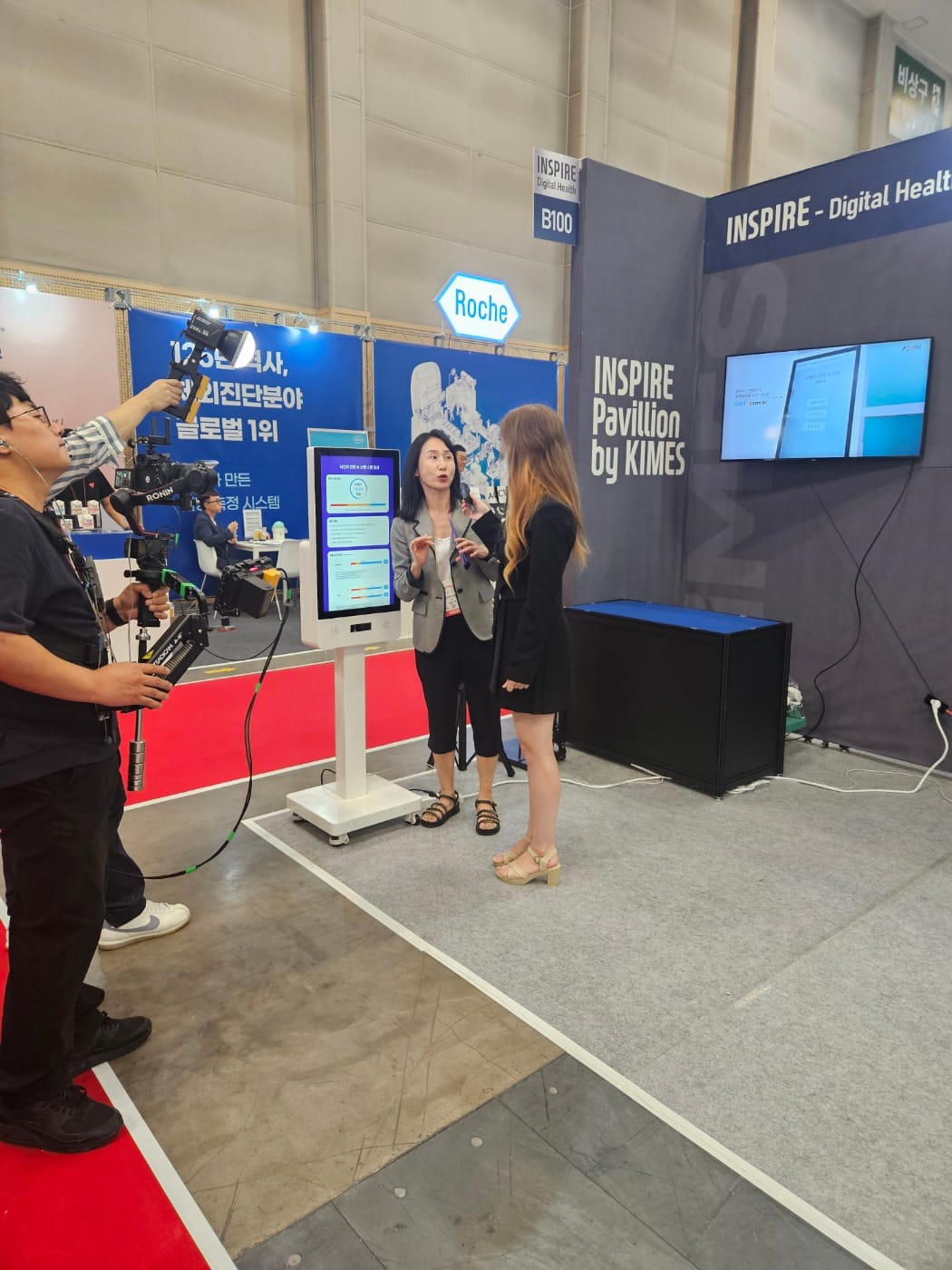
GS01, the AICU gait kiosk. One camera, one walk, no preparation.
The GS01 kiosk is a self-contained Windows appliance: a camera (with LiDAR for spatial safety) watches a short walkway. The person walks through naturally, no markers, no straps, no fitting. YOLO-based person detection and pose estimation track the walk; OpenVINO runs inference on the edge so nothing leaves the building. In roughly twenty steps, the system produces stride length, cadence, velocity, symmetry, and a composite gait_score the same kinematic parameter family a GAITRite walkway reports. A height-calibration step keeps measurements metric rather than relative. The report renders itself: the backend drives a headless browser to lay the result out as a PDF, the way a clinic expects to hand someone paper.
- One camera. No wearables, no markers, no prep., The entire measurement happens during a natural walk past the kiosk.
- ~20 steps of data, on the order of seconds of compute., Inference runs locally on the kiosk's own hardware via OpenVINO no cloud round-trip for the measurement.
- PDF, the report renders itself., Backend (Django) composes the report HTML and renders it to PDF in a headless browser, matching the clinic report layout exactly.
03 · The part that makes it real: validation against GAITRite
The model behind the kiosk is GaitNPose: a deep-learning pipeline that estimates kinematic gait parameters from monocular video. In 2021 we published its validation in Scientific Reports (Nature portfolio), demonstrating good agreement with GAITRite, the instrumented-walkway system the field treats as ground truth. That paper is the difference between "we think this works" and "here is the measurement, check our arithmetic." For a company whose products are moving toward regulated medical devices, that peer-reviewed anchor is the asset.
Since publication, the same engine has grown a fall-risk layer (multi-head fall-risk scoring plus region-of-interest analysis) and a PPE detection model, all served from the same inference stack, which is how a single validated model becomes a product family instead of a demo.
04 · Today's shape: kiosk, API, and what's next
One engine, three surfaces, and the next sensor in the line.
| Product | What it is | Status |
|---|---|---|
| GS01 KioskWalk-in appliance | Self-contained appliance: camera + LiDAR, edge inference, auto-generated PDF report | Production line · v2.x |
| Gait APICore service | /api/v1/gait → kinematic parameters + gait_score from a walking video /api/v1/pose → body keypoints from an image |
Served · FastAPI + OpenVINO |
| Fall-risk serviceOn the same Triton stack | Multi-head fall-risk scoring, ROI-locked analysis, PPE detection | Live |
| Insole ground truthWearable sensor | Wearable insole sensor (ESP32, 2.4 kHz sampling) capturing force data to train and cross-check the vision pipeline on real subjects | In field validation |
Sources: Scientific Reports paper