Free Timed Up and Go (TUG) Score Sheet (PDF)
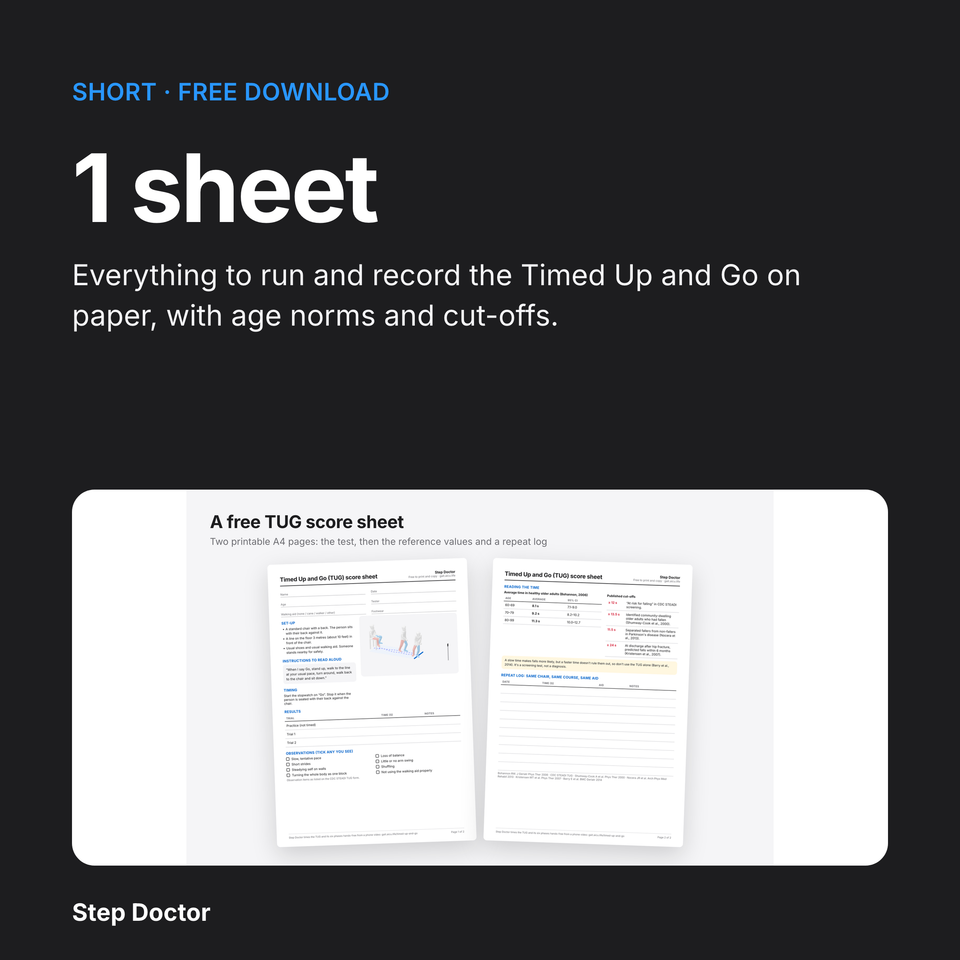
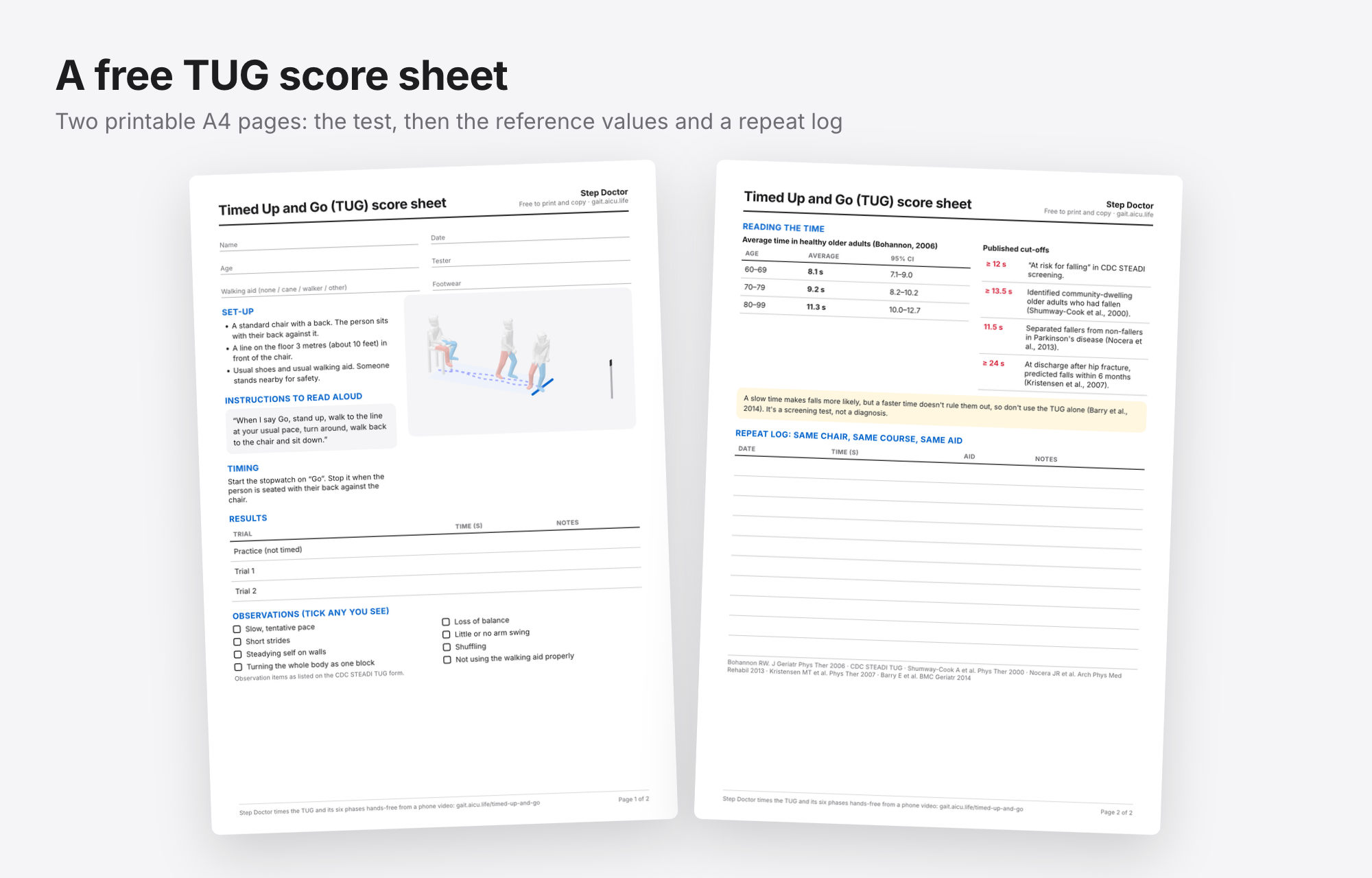
A free, printable Timed Up and Go score sheet: set-up, instructions to read aloud, results and observation checklist, age norms, published cut-offs and a repeat log, in two A4 pages.
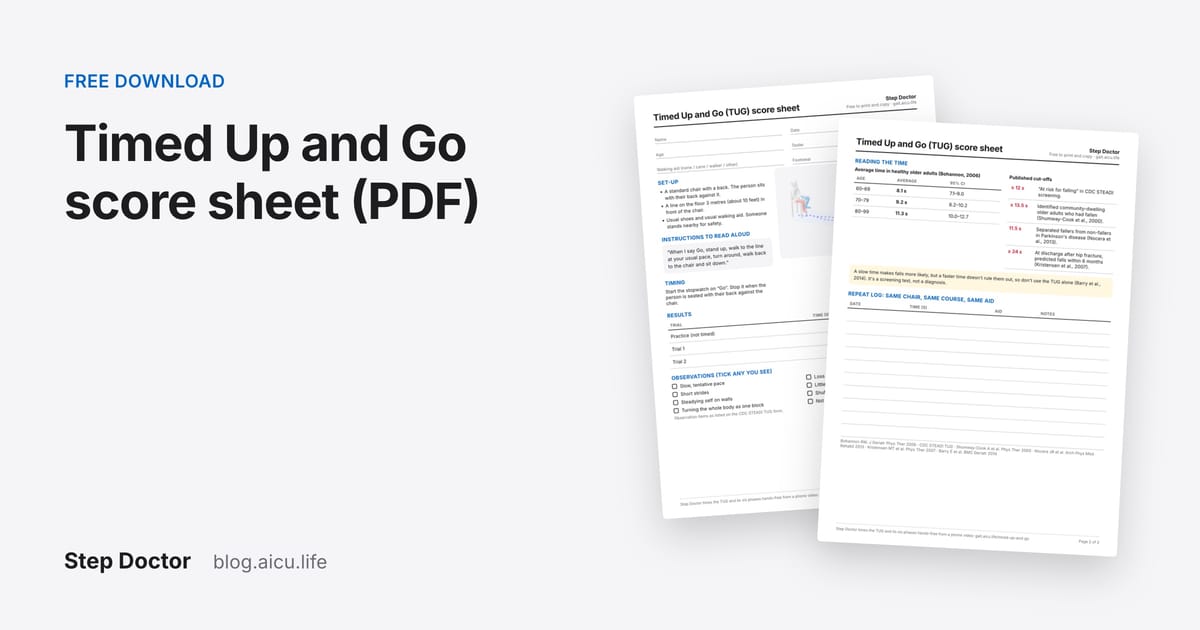
Here is a free, printable Timed Up and Go (TUG) score sheet: two A4 pages with everything needed to run the test on paper, record it and read the result. Print it, copy it and share it with your team or your patients' families. No sign-up needed.
Download the TUG score sheet (PDF, 2 pages)
What's on the sheet
Page 1, the test:
- Person, date, tester, walking aid and footwear, so repeat tests can be done the same way.
- The set-up: a standard chair with a back and a line 3 metres in front of it.
- The instructions to read aloud, word for word, and when to start and stop the stopwatch.
- A results table for a practice run and two timed trials.
- An observation checklist (loss of balance, short strides, shuffling, steadying on walls and others), with the items listed on the CDC's STEADI TUG form.
Page 2, reading the time:
- Average times in healthy older adults by age, with 95% confidence intervals (Bohannon, 2006).
- Published cut-offs: 12 seconds in CDC STEADI screening, 13.5 seconds in community-dwelling older adults, 11.5 seconds in Parkinson's disease, and 24 seconds at discharge after hip fracture.
- The caution that a faster time doesn't rule falls out (Barry et al., 2014).
- A repeat log with ten rows, to follow the same person over time.
How to run the test with the sheet
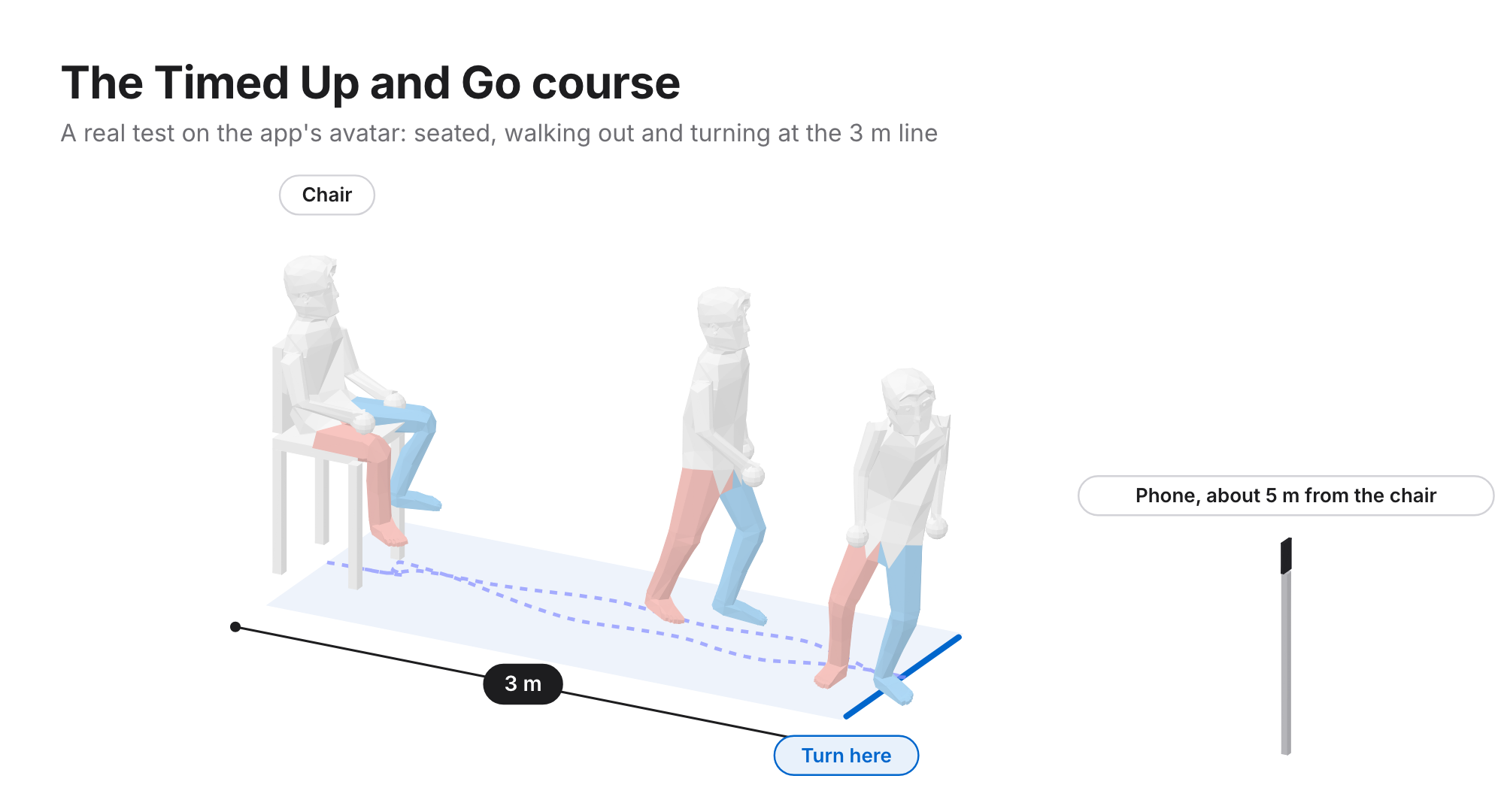
- Set up the course. Place a standard chair with a back against a wall so it can't slide, and mark a line 3 metres (about 10 feet) in front of it.
- Fill in the top of page 1. Note the walking aid and shoes: next time, use the same.
- Read the instructions aloud. The person sits with their back against the chair.
- Do one practice run without timing, so the person knows what to do.
- Time two trials. Start on "Go", stop when they're seated with their back against the chair. Stay close for safety.
- Tick what you saw in the observation checklist. How someone moves can matter as much as the time.
- Compare with page 2, using the norms for their age and the cut-off for their condition.
Reading the result
| Age | Average TUG time | 95% confidence interval |
|---|---|---|
| 60–69 | 8.1 s | 7.1–9.0 s |
| 70–79 | 9.2 s | 8.2–10.2 s |
| 80–99 | 11.3 s | 10.0–12.7 s |
A time above the upper limit for the person's age is slower than average. Cut-offs differ by condition; the full table, with the TUG variants and how much change is meaningful, is in TUG cut-offs by condition.
Paper or app?
A stopwatch and this sheet are all the standard TUG needs. An app adds what paper can't: hands-free timing when no one is there to hold the stopwatch, and the time of each part of the test. Step Doctor times the TUG and its six phases from a phone video and keeps every result for comparison. Our comparison of TUG test apps covers the options.
Questions
Can I use and copy this sheet for free? Yes. Print and copy it as often as you like, in clinics, care homes or at home.
How many trials should I time? The sheet has a practice run and two timed trials. Use the same number every time you test, so results can be compared.
What chair should I use? A standard chair with a back, the same one each time. Place it against a wall so it can't slide.
Download the TUG score sheet (PDF) · The Timed Up and Go in Step Doctor · Get Step Doctor on the App Store or Google Play.
The TUG is a screening test. A result is something to discuss with a healthcare professional, not a diagnosis.