Gait Analysis at Home: What Your Walk Says and What's Normal
What gait analysis measures, what a normal walking speed is (about 1.2–1.4 m/s in adults), the thresholds that matter for older adults and how to measure your walk at home with a phone.
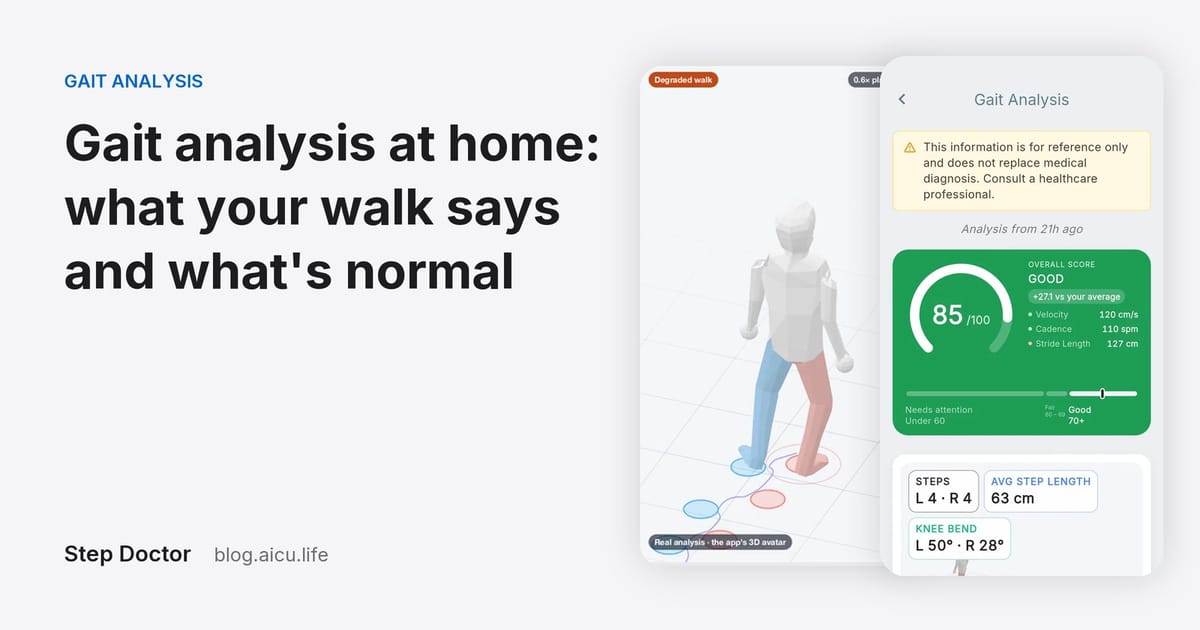
How you walk says a lot about your health. Walking speed alone is one of the most studied single measures in older adults: in a pooled analysis of nine cohorts and 34,485 older adults, gait speed was associated with survival in every cohort, and age, sex and gait speed together predicted survival as accurately as models that added mobility-aid use and self-reported function, or chronic conditions, smoking, blood pressure, body mass index and hospital stays (Studenski et al., JAMA 2011). Until recently, measuring a walk properly meant a gait lab, a pressure mat or sensors strapped to the body. This guide explains what gait analysis measures, what the numbers mean, and how to do it at home with a phone.
What is gait analysis?
Gait analysis is the measurement of how a person walks: how fast, how long each step is, how regular the rhythm is and how evenly the two legs share the work. Clinicians use it to follow recovery after surgery or a stroke, to look for early changes in balance and mobility, and to see whether exercise or treatment is working.
There are three common ways to measure it:
- Pressure-sensing walkways record every footfall on a mat. They are the reference many tools are validated against, but they live in labs and clinics.
- Body-worn sensors (including a phone in a pocket) infer steps from the movement of one point on the body. Good for all-day tracking, but they can't show the whole body.
- Camera-based analysis rebuilds the body from video. Nothing is worn, and you can watch the walk back to check what was measured.
See it: a real walk, measured from one phone video
The clip below replays two real walks recorded with Step Doctor on the app's 3D avatar (no faces are shown): a typical walk with a gait score of 84, then a slower, shorter-stepped walk that scored 23. Played at 0.6× speed; every time on screen is in real seconds.
The measures, and what they mean
| Measure | What it tells you |
|---|---|
| Walking speed | How fast you walk at your usual pace. The most studied marker of health and independence in older adults. |
| Cadence | Steps per minute: the rhythm of your walk. |
| Stride and step length | How far each foot travels, for the left and right side. |
| Step and cycle time | How long each step and each full gait cycle takes. |
| Stance and swing | The share of each cycle a foot spends on the floor and in the air. |
| Left–right balance | How closely your two sides match in step time, stride length, stance and swing. |
| Consistency | How steady your rhythm stays from one step to the next. |
What is a normal walking speed?
Normal walking speed for adults is about 1.2 to 1.4 metres per second (Fritz & Lusardi, 2009). Average comfortable speed in healthy adults ranges from about 1.43 m/s in men in their forties to about 0.94 m/s in women aged 80 to 99, across 41 studies and 23,111 people (Bohannon & Williams Andrews, 2011).
For older adults, three thresholds come up again and again:
- Under 0.6 m/s: poor health and function are more likely (a cut-off from earlier studies, cited by Studenski et al.).
- About 0.8 m/s: life expectancy close to the median for age and sex.
- 1.0 m/s or more: survival longer than expected for age and sex.
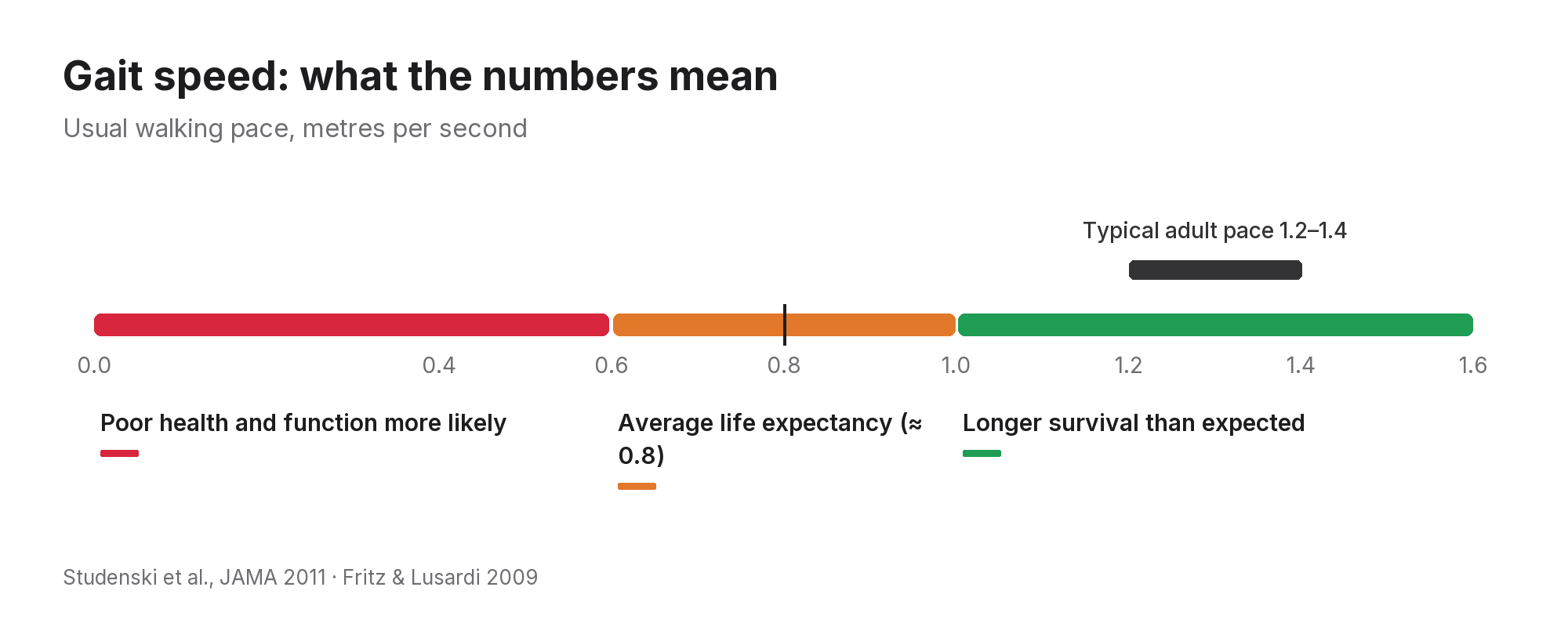
A change matters too: about 0.05 m/s is a small but meaningful change, and about 0.10 m/s a substantial one (Perera et al., 2006). That's why measuring the same way, again and again, is more useful than a single result. Every value above, with its source, is on our reference values page.
How to do a gait analysis at home
- Calibrate once. The first time, the app checks the camera with the phone standing upright and still. Each camera only needs this once.
- Stand the phone up. Prop it on a stable surface facing a straight, well-lit space with room for at least four steps, or ask someone to film. Fitted clothes help the camera see your legs.
- Walk toward the phone at your usual pace while the recording runs: 7 seconds by default, or 3, 5 or 10 seconds in settings.
- Get your result. The video is analysed in under 10 seconds after upload. You get a 0–100 gait score, every measure with its typical range, a 3D replay and a PDF report.
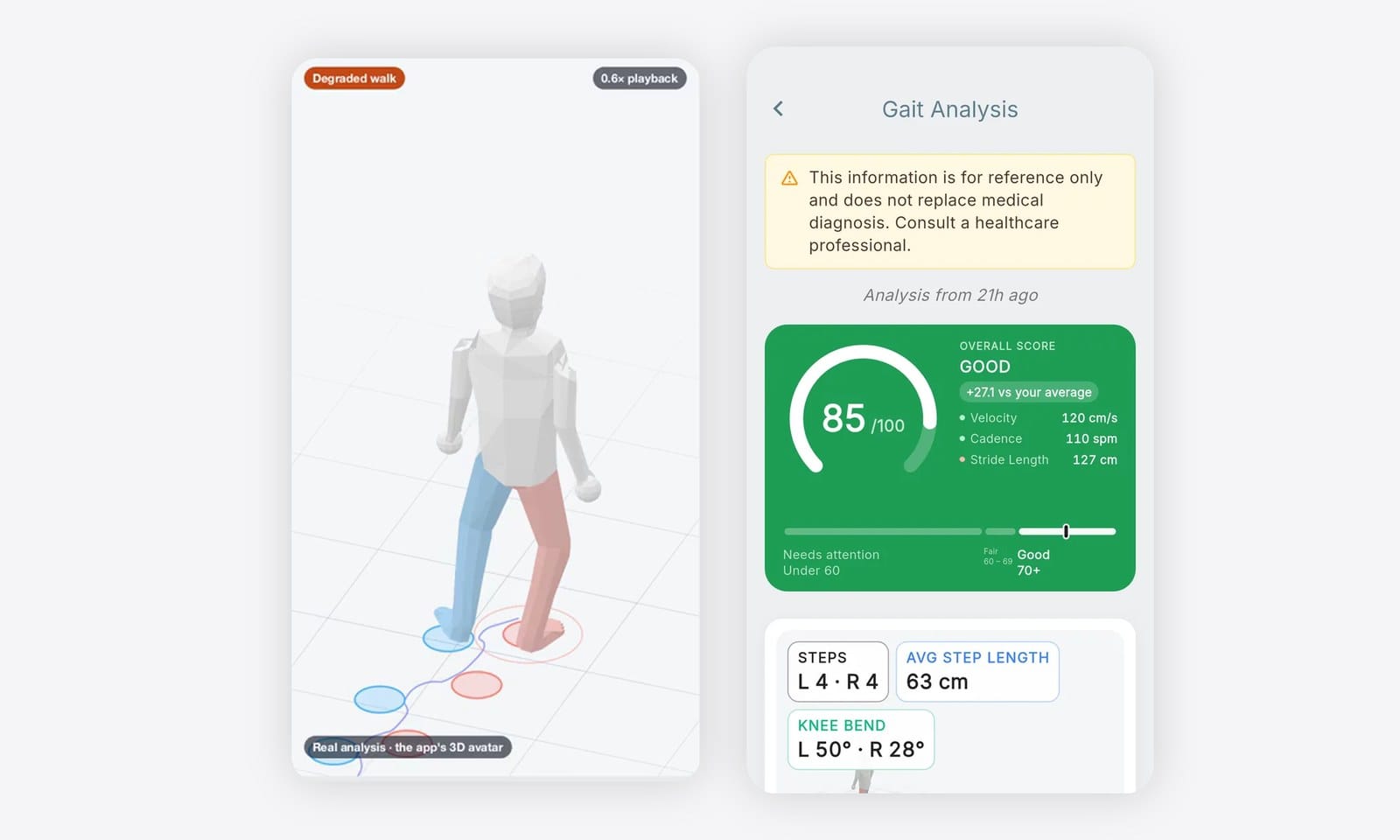
Each measure is marked Typical, Borderline or Outside range, so you can see which part of your walk needs attention, and the Stats tab follows the trend over time.
Tips for a good recording
- Walk at your normal pace. Hurrying or slowing down for the camera changes the result.
- Keep your whole body in the frame, feet included.
- Good, even light helps. Avoid walking straight into a bright window.
- Measure the same way each time (same place, similar shoes) when you're following change.
Questions
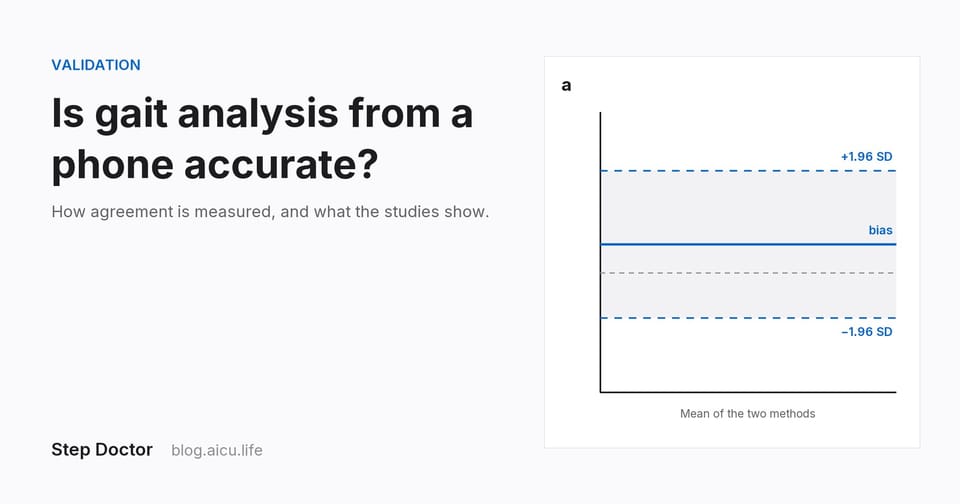
How accurate is gait analysis from a phone video? Step Doctor reconstructs the body in 3D from ordinary video, without markers or sensors. We compared its measurements with a pressure-sensor walkway in an internal study; that study is not yet peer-reviewed, and we'll publish the method and results. The science page explains what has and hasn't been validated.
Is a gait score a diagnosis? No. It's a summary of how you walked in that recording, useful for screening and for following change over time. Talk to a healthcare professional about any result that worries you.
Does someone need to film me? No. Prop the phone on a stable surface and walk toward it, or have someone hold it.
Related: the Timed Up and Go test, SPPB scoring and how Step Doctor measures movement.
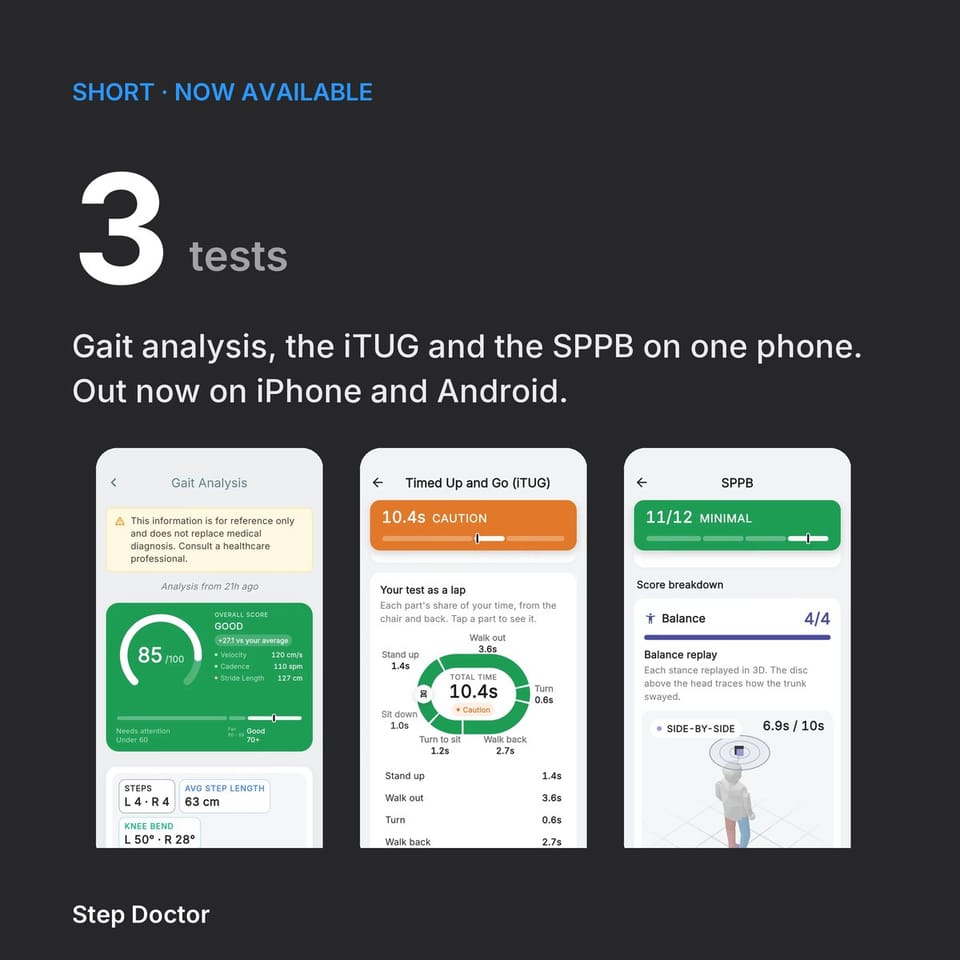
Step Doctor runs gait analysis, the instrumented Timed Up and Go and the SPPB on iPhone and Android. Read more about gait analysis in Step Doctor, or download it from the App Store or Google Play.
Step Doctor supports screening and monitoring. It doesn't diagnose, and results should inform, not replace, the judgement of a healthcare professional.