A Gait Analysis App for Older Adults and Physiotherapy: What to Measure
What a gait analysis app for older adults and physiotherapists should measure, what walking speed and step length mean, two real walks compared, and a routine that shows real change.
Most gait analysis apps are built for runners: foot strike, pronation, cadence for speed. Older adults and the physiotherapists who work with them need something else: walking speed, step length and balance at a usual pace, measured the same way every few weeks, with a record a clinician can read. This guide explains what a gait analysis app for older adults and physiotherapy should measure, what the numbers mean, and how to build a routine that shows real change.
Why walking speed matters in older adults
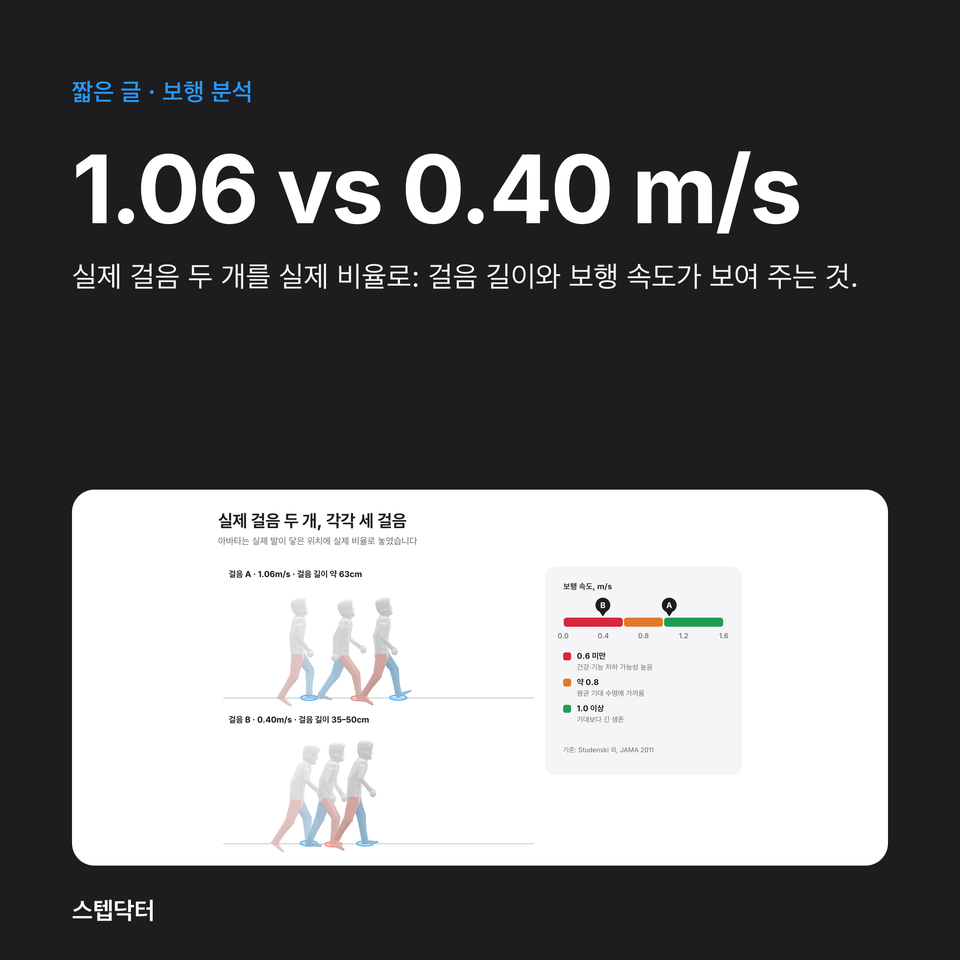
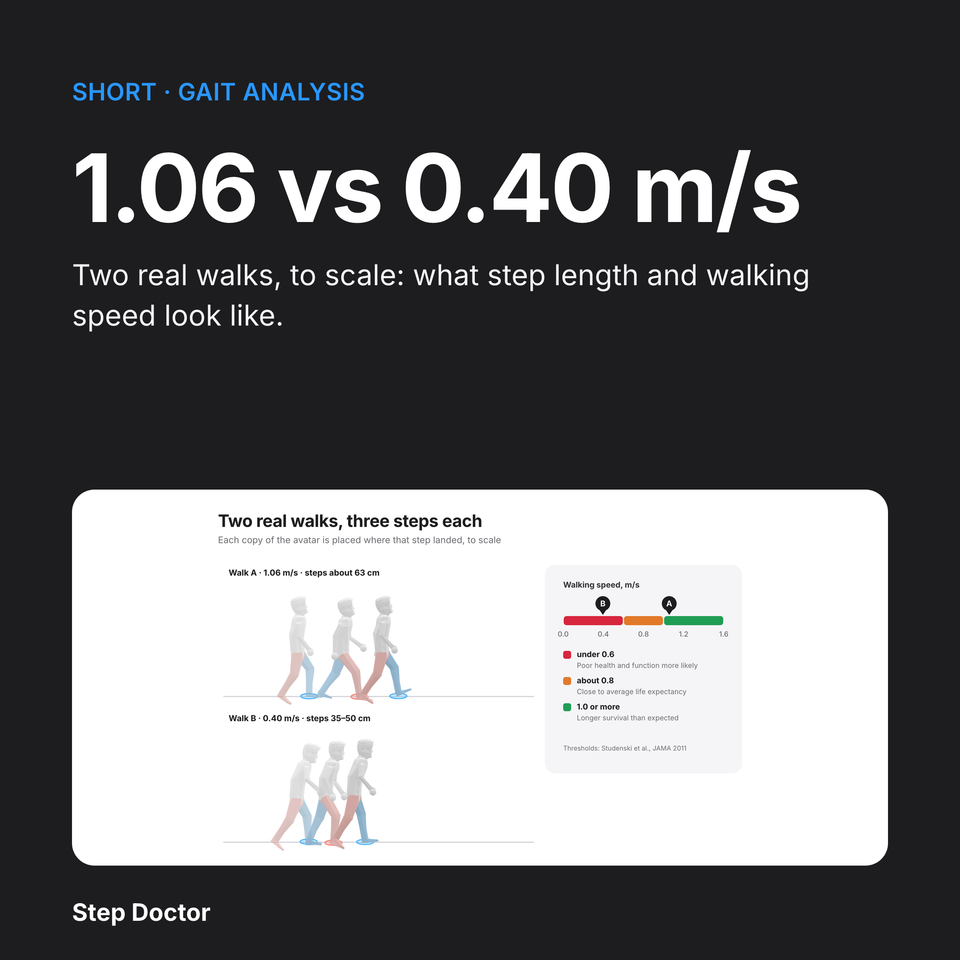
Usual walking speed is one of the most studied single measures in older adults. In a pooled analysis of nine cohorts and 34,485 people, it was associated with survival in every cohort (Studenski et al., JAMA 2011). Three numbers are worth knowing: under 0.6 m/s, poor health and function are more likely (a cut-off from earlier studies, cited by Studenski et al.); about 0.8 m/s is close to average life expectancy for age and sex; 1.0 m/s or more goes with longer survival than expected. For comparison, normal adult walking speed is about 1.2 to 1.4 m/s (Fritz & Lusardi, 2009).
What the numbers look like: two real walks
The figure shows two real walks recorded with Step Doctor, three steps each, with the app's avatar placed where each step landed. Walk A is at a typical pace; walk B is much slower, with shorter and less even steps.
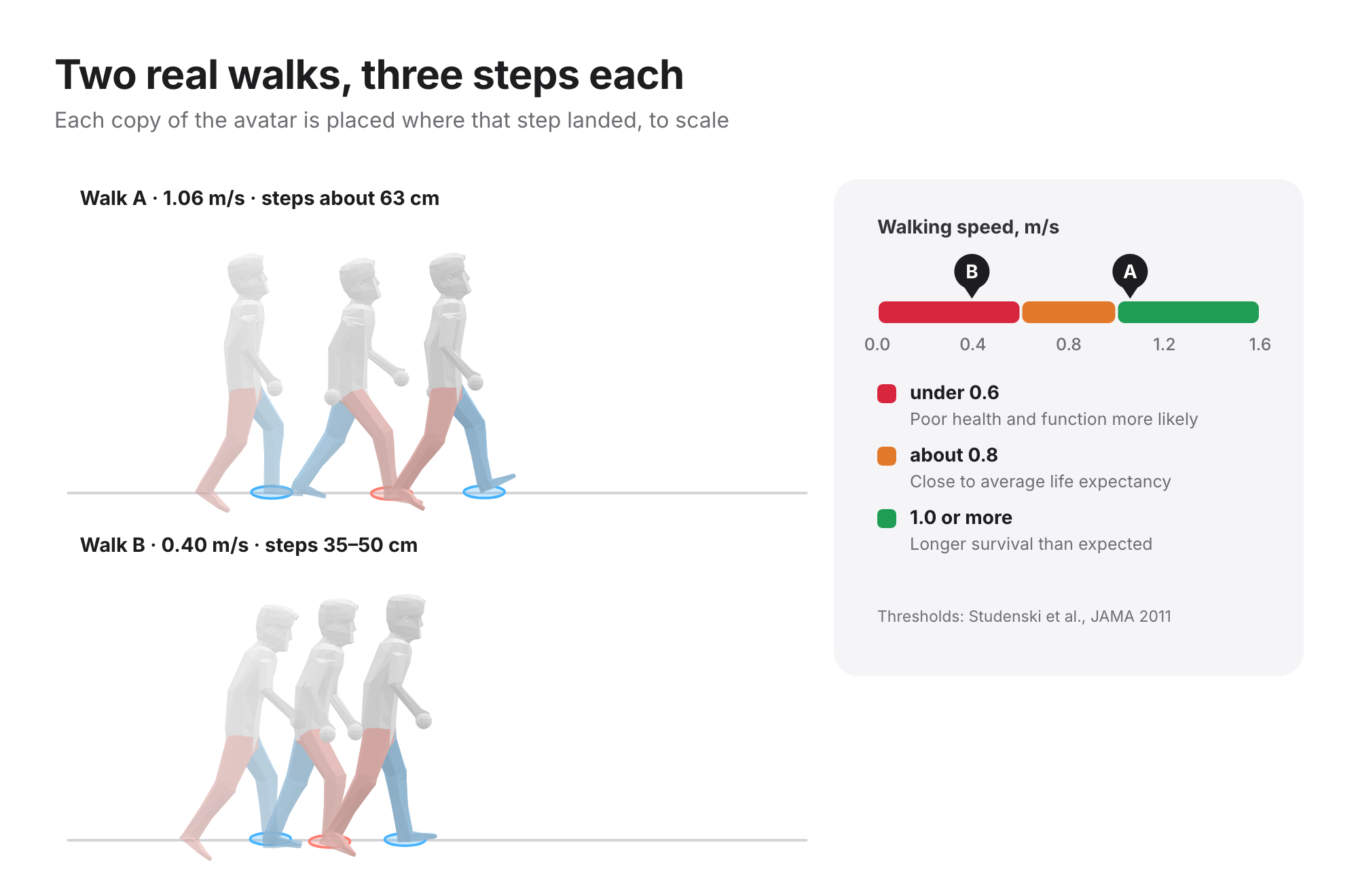
The difference you can see is the difference the measures capture: speed, step length, and how evenly the two sides share the work. Watching the replay next to the numbers is what lets a physiotherapist check that a slow result reflects the walk, not a poor recording.
What a gait app for older adults should measure
| Measure | Why it matters for older adults |
|---|---|
| Walking speed | The most studied marker of health and independence, with published thresholds and meaningful-change values. |
| Step and stride length | Shorter steps are a common way of walking more cautiously. |
| Cadence | Steps per minute. Together with step length, it shows how speed is produced. |
| Left–right balance | Differences between sides can follow pain, surgery or a stroke, and can change with rehabilitation. |
| Consistency | How steady the rhythm stays from one step to the next. |
Each measure is only useful next to a typical range and a source. Every reference value we use is on our reference values page.
A routine that shows change
A single gait analysis is a snapshot. The value for older adults and their physiotherapists comes from repeating it. For walking speed, about 0.05 m/s is a small but meaningful change and about 0.10 m/s a substantial one (Perera et al., 2006), so the conditions have to stay the same or a real change will be lost.
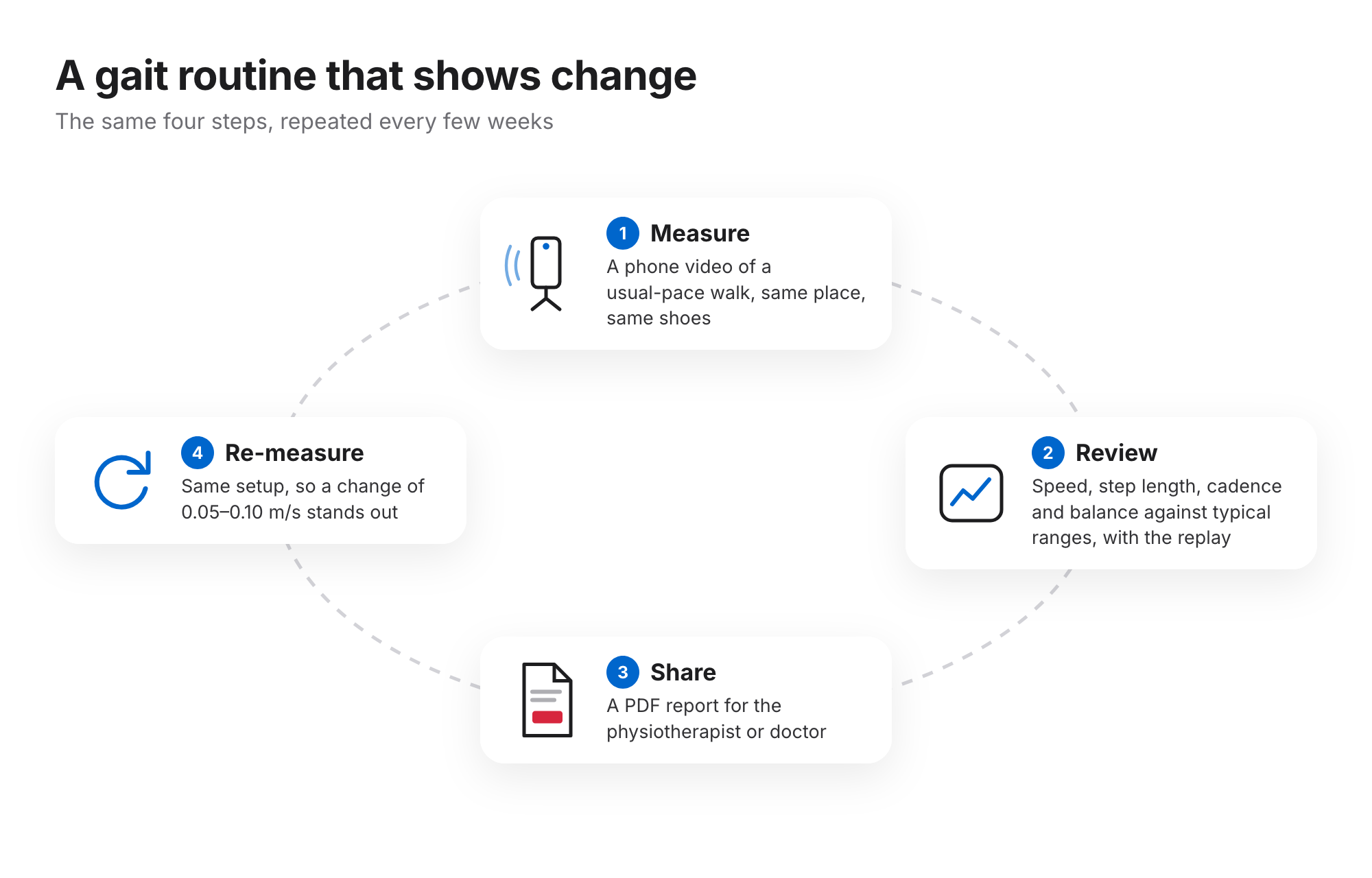
- Measure: the same place, the same shoes, the usual pace, with the phone propped up and the whole body in frame.
- Review: each measure against its typical range, with the replay.
- Share: a PDF report the physiotherapist or doctor can read, and keep with the notes.
- Re-measure: every few weeks, or after a change in treatment, in the same way.
For physiotherapists: where an app fits
- Baseline and follow-up. The same measure at the first visit and at review, recorded the same way.
- Between visits. A family member can film a walk at home, so you see how someone walks where they actually live.
- An objective record. Numbers with typical ranges and a replay are easier to compare, explain and share than notes alone.
- Not a replacement. An app measures a walk; it doesn't examine, diagnose or decide. It informs your judgement.
Choosing between apps? Our gait analysis apps comparison covers camera, phone-sensor, insole and walkway options, and the validation guide explains how to read their evidence.
Questions
What is the best gait analysis app for older adults? One that measures walking speed, step length and balance at a usual pace, shows typical ranges with sources, lets you check the walk it measured and produces a report you can share. Running apps measure different things.
What walking speed is a concern in older adults? Under 0.6 m/s makes poor health and function more likely; 1.0 m/s or more goes with longer survival than expected (Studenski et al., 2011).
How often should an older adult's gait be measured? Often enough to see a trend, always the same way. Every few weeks, or after a change in health or treatment, is a common rhythm; agree it with the care team.
Can a physiotherapist use results recorded at home? Yes, if the walk was recorded the same way each time. A report with the measures, their ranges and a replay makes home results easier to judge.
Step Doctor is a gait analysis app for iPhone and Android: one phone video gives walking speed, step length, cadence and left–right balance, a 3D replay and a PDF report. Get it on the App Store or Google Play.
Step Doctor supports screening and monitoring. It doesn't diagnose, and results should inform, not replace, the judgement of a healthcare professional.